
Published: February 2026 | By Dr Ezi, Az’Fredrick, PhD | Chartered Member, British
Psychological Society. Founder of Hearty Talk
EXECUTIVE SUMMARY
- Grief is not a single emotion; it is a complex, biological and psychological response to loss that affects your body, mind, and behaviour, often in ways you don’t immediately recognise.
- It does not end. It transforms. The goal is not to get over it, rather to integrate it and build forward with clarity about what that costs and what it makes possible.
- There are eight distinct types of grief. You may be experiencing more than one simultaneously, and identifying which ones is the beginning of knowing what you actually need.
- If you’re a high achiever, you may be experiencing grief without identifying which type and without identification or awareness, you cannot seek the right support. Understanding your grief type reduces self-judgment, isolation, and the pressure to ‘perform’ recovery.
- Six of the most damaging grief myths are examined here, including the one that tells driven people their grief is a weakness.
- This article is a foundational reference: research-grounded, peer-reviewed, fully cited, and written for people who need more than reassurance.
- If you have three minutes, the bullets above tell you what this article establishes. If you have more time, everything below is written with direct relevance to your context.
What Is Grief? A Research-Grounded Definition
You have achieved extraordinary things. You know how to manage difficulty, absorb setbacks, and
keep moving under conditions that would stop most people. And then grief arrived, and none of that worked. This is not a character flaw. It is biology. Grief is the natural, multidimensional response to significant loss. Although most commonly associated with the death of a loved one, grief arises after any major disruption to life, identity, relationship, or meaning, the end of a career, the collapse of a vision, the loss of a mentor, the dissolution of a marriage, or a diagnosis that rewrites the future you had planned. Psychological research confirms that grief affects every system simultaneously, emotional, cognitive, physical, and behavioural (Stroebe, Schut, & Boerner, 2017). It is not a single emotion. It is a constellation of responses that the brain and body generate when something essential has been lost.
The American Psychological Association (APA) defines grief as “The anguish experienced after significant loss… often including physiological distress, separation anxiety, confusion, yearning, obsessive dwelling on the past, and apprehension about the future.”
(APA, 2023)
For high achievers, this definition carries a specific implication: grief is not a cognitive or volitional
process. It is a biological one. You cannot think your way out of it, schedule it into compliance, or
resolve it through the same strategic intelligence that has driven everything else you have built.
Understanding this, not just intellectually acknowledging it, is where recovery begins.
Grief is distinct from:
- Bereavement — the objective state of having experienced a loss
- Mourning — the external, cultural, or social expression of grief (Rosenblatt, 2017)
- Depression — a clinical disorder that can overlap with grief but is diagnostically distinct.
Grief is a natural process that typically transforms over time, while depression is a persistent
clinical condition requiring its own treatment (Bonanno, 2009)
Modern grief theory emphasises that grief does not disappear; it transforms. Through a process of
meaning reconstruction and continuing bonds, most bereaved individuals develop a new
relationship with their loss, one that carries the person or experience forward into a life that is different from, but not lesser than, the one that existed before (Neimeyer, 2019; Klass, Silverman, & Nickman, 1996).
The Physical Reality of Grief: What High Achievers Need to Know
Before examining the types of grief, it is worth addressing something that high achievers consistently underestimate: grief is physically painful, and that is not a metaphor. Neuroimaging research by O’Connor et al. (2008) demonstrated that grief activates the anterior cingulate cortex, the same brain region that processes physical pain. The exhaustion of grief is real and physiological. The cognitive impairment, the inability to concentrate, the forgetfulness, the sense of operating at reduced capacity, is the measurable cost of an uneasy system under sustained biological stress. For high achievers whose professional identity is built on cognitive performance, this matters practically. You are not underperforming because you are weak. You are operating a high-performance system under conditions it was not designed to sustain indefinitely. Recovery is not just psychological work. It requires what the nervous system requires: adequate sleep, nutrition, social connection, and sufficient time.
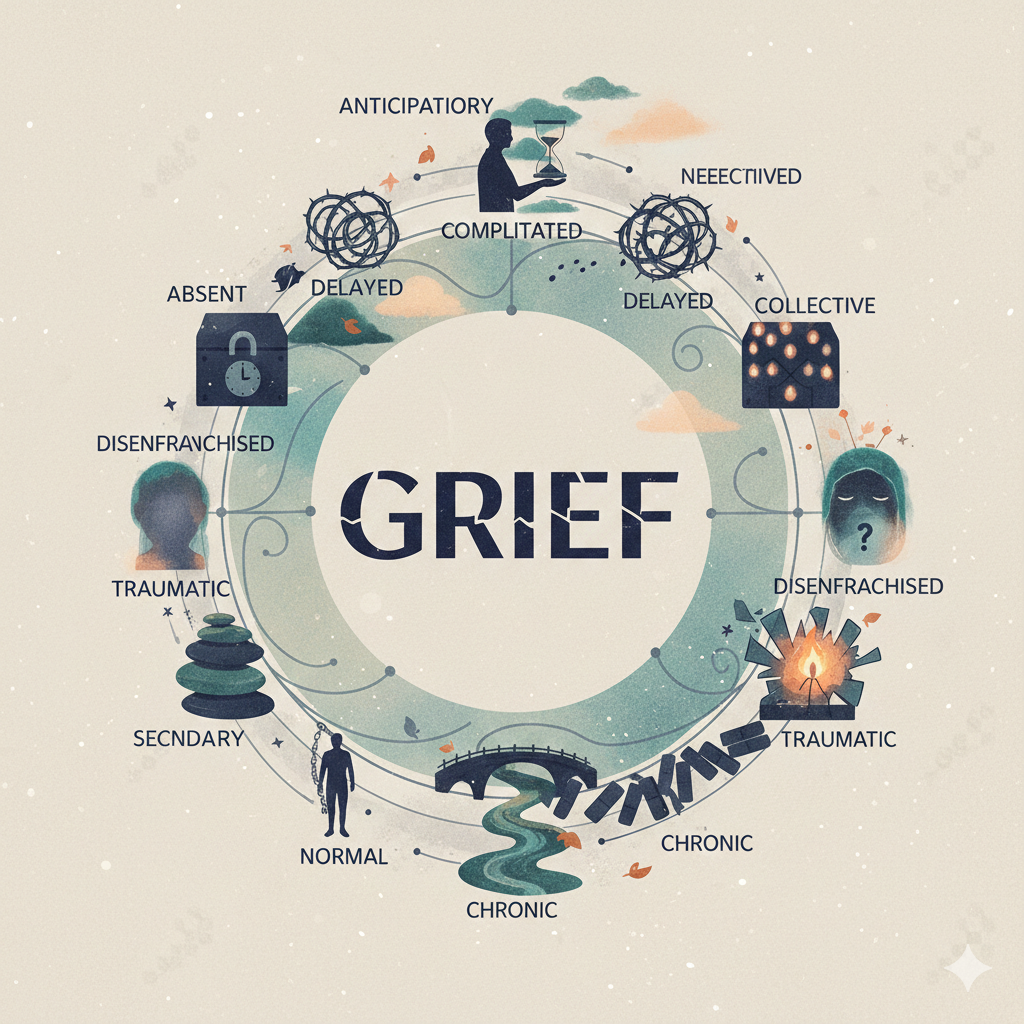
Eight Types of Grief: Which One Are You Carrying?
Grief is not one-size-fits-all. Research identifies eight distinct forms, each with its own characteristics, triggers, and implications for recovery. Many people carry more than one simultaneously, and recognising which types are present is a meaningful act of self-understanding that reduces confusion, self-judgment, and the exhausting attempt to grieve in the wrong way for the type of loss you have actually experienced.
1. Normal (Uncomplicated) Grief
The most common and adaptive form of grief. Emotions arrive in waves, intense initially, gradually softening as the individual adjusts to life after the loss. Normal grief is non-linear, deeply personal, and follows no fixed timeline. Bonanno’s (2009) longitudinal research established that approximately 35–65% of bereaved individuals follow a resilience trajectory, maintaining relatively stable functioning while experiencing genuine sadness and loss. For high achievers: If you are functioning well and feeling guilty about it, wondering whether your capacity to keep going means you did not love enough, this is the misconception addressed in full below. Resilience in grief is not the absence of love. It is a valid grief trajectory.
2. Anticipatory Grief
Grief that begins before the loss itself. During a terminal illness, an impending divorce, an
expected redundancy, or any situation in which a significant loss is foreseeable. It may involve
sadness, anxiety, guilt, and the painful experience of grieving something that has not yet gone
(Shore et al., 2016).
For high achievers: Anticipatory grief often activates the control paradox — the desperate attempt
to plan, prepare, and manage what cannot be managed. The grief is real. The attempt to strategise
around it is understandable. But the emotional processing that anticipatory grief requires cannot be
substituted by preparation.
3. Complicated Grief / Prolonged Grief Disorder (PGD)
Some individuals experience grief that remains at clinically significant intensity well beyond the
expected adjustment period. The DSM-5-TR (American Psychiatric Association, 2022) defines
Prolonged Grief Disorder as grief persisting at significant intensity for at least 12 months in adults,
characterised by intense yearning, identity disruption, difficulty re-engaging with life, and
emotional numbness occurring nearly every day and causing significant impairment.
Risk factors include sudden or traumatic loss, prior trauma, insecure attachment, and limited social
support (Shear, 2015).
For high achievers, PGD is particularly dangerous because it is invisible.
Professional performance can remain intact, meetings are attended, deadlines are met, leadership
is maintained, while internally, the capacity to feel genuine joy, imagine a meaningful future, or
fully engage with living relationships has stalled completely. If you have been significantly
struggling for more than 12 months, this is not a failure of determination. It is a clinical condition
that responds to specific, evidence-based treatment. Seeking it is the most strategically intelligent
decision available to you.
4. Disenfranchised Grief
Coined by Kenneth Doka (2002), disenfranchised grief refers to grief that society does not formally
acknowledge or validate — losses that exist outside the cultural scripts for what constitutes a real or
serious loss. Examples include miscarriage, pregnancy loss, suicide, bereavement, pet loss, grief
following addiction, loss of a role or identity, and the grief of estrangement.
For high achievers: The loss of a mentor, a professional identity, a business, or a vision for the
future often falls into this category. These are not the losses that prompt condolence cards or
bereavement leave. But they are genuine losses, and the grief they generate is genuine,
deserving of the same acknowledgement and support as any other form. When this type of grief is minimised, you may feel isolated and without adequate support.”
5. Ambiguous Loss
Described by Pauline Boss (2006), ambiguous loss occurs when there is no clear closure — when
the loss is real but unresolved or unresolvable. Examples include a missing person, a parent with
dementia who is physically present but psychologically absent, estrangement from a living family
member, or the loss of a future that was planned but never materialised.
The particular difficulty of ambiguous loss is that the normal grief processes — acknowledgement,
ritual, closure — are not available. The loss cannot be fully grieved because it is not fully defined.
For high achievers who need clear problems with clear solutions, ambiguous loss is among the most
disorienting grief experiences available.
6. Cumulative Grief
Grief arising from multiple losses accumulating over time, several bereavements in close
succession, or a series of different types of loss (health, relationship, career, identity) that compound
one another. The emotional load can become overwhelming, particularly when each loss has not
been fully processed before the next arrives (Rando, 1993).
For high achievers: The drive to keep moving means that individual losses are often not fully
processed before the next demand arrives. Cumulative grief is the predictable consequence a
weight that has been accumulating quietly beneath the surface of continued high performance, until
it can no longer be managed by forward motion alone.
7. Collective Grief
Grief experienced by communities or societies following large-scale events — pandemics, natural
disasters, national tragedies, or the loss of a shared cultural figure. Collective grief can foster
solidarity and shared meaning, but it also overwhelms support systems and may leave individuals
feeling that their personal grief is secondary to the larger loss (Eisma et al., 2020).
For high achievers in leadership roles: Collective grief creates a specific pressure — the
expectation to hold the team’s grief while privately navigating your own. This is one of the loneliest
grief experiences available, and it is worth naming directly.
8. Traumatic or Sudden Grief
Grief following unexpected, sudden, or violent loss, which frequently overlaps with trauma
responses including intrusive memories, hypervigilance, avoidance, and symptoms consistent with
post-traumatic stress disorder (Kristensen, Weisæth, & Heir, 2012). The shock of sudden loss
removes the anticipatory processing that gradual loss allows, and the traumatic dimension can
significantly complicate and extend the grief process.
The High Achiever’s Grief: What Makes It Different
“Before addressing the common misconceptions, it is worth naming the patterns that make grief in high achievers specifically distinctive, because understanding your particular vulnerabilities is the beginning of navigating them with clarity.”
The productivity trap. Work becomes the primary coping mechanism. Busyness creates distance
from the pain. This is functionally understandable, and it delays recovery. The grief does not
resolve while you are running from it. It accumulates.
The identity paradox. High achievers whose sense of self is most strongly built through
achievement and forward momentum are particularly vulnerable to the identity disruption of major
loss. When the loss removes the person, role, or future that the achievement narrative was oriented toward, the question “who am I now?” can be genuinely destabilising in ways that performance
alone cannot address.
The guilt of resilience. High achievers who cope well often carry a specific guilt, the fear that
their capacity to function is evidence of insufficient love or inadequate grief. It is not. Resilience is
a valid grief trajectory. Coping well does not mean you did not care deeply.
The control paradox. High achievers are accustomed to influencing outcomes through effort and
strategy. Grief is the experience that most completely resists this. The inability to resolve grief
through determination is not a failure of character. It is the nature of grief, and recognising this is
the beginning of meeting it more honestly.
The performance facade. The professional mask that high achievers wear is highly functional in
most contexts. In grief, it becomes a barrier to recognition, to support, and to the permission to be
honest in the experience, rather than performing recovery for the benefit of everyone around them
A Note on Faith and Grief
For those who navigate loss within a faith framework, and many high achievers do, the relationship between grief and faith deserves acknowledgement.
Faith does not prevent grief. It accompanies it. The Psalms of lament, the silence of Holy Saturday after cruxifition of Jesus, the long waiting of Advent, the Christian tradition in particular, have a rich theology of grief that does not rush toward resolution, does not demand performed acceptance, and does not
equate faith with the absence of pain.
For those for whom faith is part of the recovery journey, it belongs here. The science of grief and
the theology of lament are not in conflict. They address the same human experience from different
angles, and for many people, both are needed. The invitation is to use whatever resources genuinely to serve your recovery and to seek support that reflects the full complexity of who you are.
Six Common Grief Misconceptions and Why They Are Particularly Harmful to High
Achievers
Misconception 1: Grief follows predictable, linear stages.
The five stages model, denial, anger, bargaining, depression, acceptance, is the most widely
known grief framework and one of the most consistently misapplied. Kübler-Ross herself did not
intend the stages as a universal sequence. They were observations, not a prescription.
Research by Bonanno (2009) and Stroebe, Schut, and Boerner (2017) demonstrates clearly that
grief is non-linear, cyclical, and highly individual. Most bereaved people do not experience all five
stages, do not experience them in order, and do not move through them once and arrive somewhere
called healed.
For high achievers specifically, the stages model is dangerous because it implies a project plan.
High achievers apply it as a schedule they expect to complete denial, move to anger, progress
through bargaining, and arrive at acceptance on a reasonable timeline. When grief does not
cooperate, they conclude they are doing it wrong. They are not. The stage model is not a timetable.
Misconception 2: Grief only follows death.
Grief is a response to a significant loss of any kind. The loss of a career, a marriage, a vision of the
future, a professional identity, a mentor, a business, or physical health can all generate genuine grief. These losses are real. The grief they produce is real. And they deserve the same acknowledgement and support as bereavement.
For high achievers: Many of the losses most central to high-performance life, like loss of a mentor,
loss of a company, loss of a professional role, loss of a vision, are precisely the losses that grief
culture does not validate. You may have been carrying genuine grief for years without permission to
name it as such.
Misconception 3: Time heals all wounds.
Time alone does not heal grief. What heals grief is what you do with the time, the active processing, the meaning-making, the integration of the loss into a revised life narrative. Unprocessed grief does not dissolve with the passage of time. It accumulates, typically surfacing later with greater intensity at a moment of life transition or secondary loss (Rando, 1993).
For high achievers: The implicit belief that forward momentum, keeping busy, staying
productive, and making progress is equivalent to processing grief is one of the most common and
consequential misconceptions in this population. Movement is not processing. Recovery requires
both.
Misconception 4: If you are functioning, you are fine
Functioning and recovering are not the same thing. High achievers can maintain extraordinary
levels of professional performance while internally experiencing disruption, emotional
numbness, inability to imagine a meaningful future, and persistent absence of genuine joy that
characterise complicated grief. The professional facade is real. The internal experience beneath it is
also real.
For high achievers specifically, this misconception is the one that most consistently delays
appropriate support-seeking. If you are performing well but privately feel that something
fundamental has not moved, that the loss is not integrating, that joy requires too much effort, this is important information to act on.
Misconception 5: Grief is a sign of weakness
Grief is the natural expression of attachment to having loved something or someone deeply
enough that its loss registers as significant. The vulnerability of grief is not weakness. It is the direct
evidence of the depth of the connection that has been lost. Research consistently demonstrates that the suppression of grief, the performance of strength in the face of loss, is associated with worse long-term outcomes, including higher rates of complicated grief, physical health consequences, and delayed grief that arrives with greater intensity at a later point (Bonanno, 2009).
For high achievers: The cultural scripts of high-performance self-sufficiency, emotional management, and strength under pressure are genuinely adaptive in most contexts and genuinely counterproductive in grief. Recognising the difference is not weakness. It is self-awareness at its best.
Misconception 6: Recovery means moving on.
Recovery from grief does not mean leaving the loss behind, forgetting the person or experience that
has been lost, or returning to who you were before. Modern grief theory particularly the
continuing bonds framework (Klass et al., 1996) and Neimeyer’s meaning reconstruction approach
(2019) highlights recovery as integration: the development of a new relationship with the loss
and with the continuing inner presence of what has been lost, within a life that moves forward
honestly and with full acknowledgement of what that cost.
For high achievers: The reframe that matters here is that recovery is not a return. It is a reconstruction, the deliberate, intelligent, ongoing construction of a life that carries both the loss and what remains possible. This is work that engages your genuine strengths. It simply requires that those strengths be directed honestly at what is actually happening, rather than at the performance of having moved on.
Why This Matters & Your Next Steps
Understanding the definitions, types, and misconceptions of grief is not an academic exercise. It is
the foundation of honest self-assessment, knowing what is happening to you, naming it
accurately, and understanding what it actually requires.
If you recognise yourself in the high achiever patterns described above, the productivity trap, the
guilt of resilience, the performance facade, the most important next step is not to try harder. It is
to create space. For the grief to be present. For the support that fits your experience to be
sought. For the recovery that is genuinely available to you to begin.
Explore Further on Hearty Talk:
- Valentine’s Day Grief Guide for widows/widowers2026
- Valentine’s Day Survival Guide after Breakups and Divorce
- Grief Recovery Models: A Complete Guide for High Achievers (Pillar Post)
- Prolonged Grief Disorder: When to Seek Help (Deep Dive)
- Bonanno’s Resilience Framework: The Guilt of Coping Well
- Dual Process Model: Why Staying Busy May Be Delaying Your Grief
- Continuing Bonds Theory: You Don’t Have to Let Go to Move Forward
- Work With Dr Ezi: If you are ready for direct support, through group coaching or a structured
online programme — visit the Work With Me page.
You’re Invited
Which type of grief do you most recognise in your own experience right now? Has any
misconception been shaping how you have understood or judged your own grief? Share in the
comments below, anonymously if you prefer. Your reflection may be exactly what another reader
needs to feel less alone in what they are carrying.
Warmly,
Dr. Ezi Az’Fredrick.
Founder, HeartyTalk |Grief Coach.
Reference List
American Psychiatric Association. (2022). Diagnostic and statistical manual of mental disorders (5th ed..).
American Psychological Association. (2023). APA dictionary of psychology.
Bonanno, G. A. (2009). The other side of sadness: What the new science of bereavement tells us about life after loss. Basic Books.
Boss, P. (2006). Loss, trauma, and resilience: Therapeutic work with ambiguous loss. W. W. Norton.
Doka, K. J. (2002). Disenfranchised grief: New directions, challenges, and strategies for practice. Research Press.
Eisma, M. C., Boelen, P. A., & Lenferink, L. I. (2020). Prolonged grief disorder following the Coronavirus (COVID‑19) pandemic. Psychiatry Research, 288, 113031. https://doi.org/10.1016/j.psychres.2020.113031
Klass, D., Silverman, P. R., & Nickman, S. (1996). Continuing bonds: New understandings of grief. Taylor & Francis.
Kristensen, P., Weisæth, L., & Heir, T. (2012). Bereavement and mental health after sudden and violent losses: A review. Psychiatry: Interpersonal and Biological Processes, 75(1), 76–97. https://doi.org/10.1521/psyc.2012.75.1.76
Neimeyer, R. A. (2019). Meaning reconstruction in bereavement: Development of a research program. Death Studies, 43(2), 79–91. https://doi.org/10.1080/07481187.2018.1456620
Rando, T. A. (1993). Treatment of complicated mourning. Research Press.
Rosenblatt, P. C. (2017). Grief in small doses: Stories of loss and life. Routledge.
Shear, M. K. (2015). Complicated grief. The New England Journal of Medicine, 372(2), 153–160. https://doi.org/10.1056/NEJMcp1315618
Shore, J., Gelber, M., Koch, R., & Sacks, N. (2016). Anticipatory grief: A review. Journal of Social Work in End-of-Life & Palliative Care, 12(1–2), 1–21. https://doi.org/10.1097/NJH.0000000000000208
Stroebe, M., Schut, H., & Boerner, K. (2017). Cautioning health-care professionals: Bereaved persons are misguided through the stages of grief. Omega: Journal of Death and Dying, 74(4), 455–473.